John Reece

John Reece was born on September 3, 1853, in Stanstead County, Canada. From an early age, he proved to be exceptionally gifted in technical matters. Before the age of twenty, he is said to have built and installed a complete pipe organ in a church in Vermont, Canada, where he lived at the time.
Reece pursued a technical education and turned his talent into a profession. He repaired sewing machines, both for housewives and for industrial companies. At that time, many clothing factories were already using sewing machines, but buttonholes were still sewn by hand. Although more than eighteen patents for buttonhole machines already existed, no truly practical model had yet been developed.
At the age of eighteen, John Reece, together with O. Morill, started a small iron foundry and mechanical workshop in Rock Island, Canada. Two years later, he was already selling self-built sewing machines that, according to contemporaries, were renowned for their high quality.
With this solid foundation, he embarked on an ambitious project he had long envisioned: developing a reliable buttonhole machine. His great insight lay in realizing that such a machine should not only be able to sew the buttonhole automatically but also cut it open at the same time—an idea that was groundbreaking at the time.
After years of development, John Reece succeeded in building a fully functional automatic buttonhole machine, which became known as the Reece J Machine. For this revolutionary invention, he was granted U.S. Patent No. 240,256 on April 26, 1881. With it, he laid the foundation for a technical achievement that would permanently transform clothing production.
Reece Button-Hole Sewing Machine Co.


The successful development of the buttonhole machine did not go unnoticed. It soon became clear that it also held great commercial potential. This led, in 1881, to the founding of a specialized company: the Reece Button-Hole Sewing Machine Co.
The company was officially registered in Portland, Maine (USA), while production of the machines began in rented workshops in Boston. Thus, not only was a technical masterpiece born, but also a successful enterprise that would permanently influence the industry.

The first building, in 1881.
he building in which the Reece machines were initially produced holds a special historical significance: Alexander Graham Bell also worked there on the development of the telephone. According to some sources, Bell may even have collaborated with John Reece on other technical innovations.
In 1883, a second company was established: the International Button Hole Sewing Machine Company. The purpose of this company was specifically to manage leasing agreements for the Reece buttonhole machines. Since these advanced machines were very expensive, the leasing model gave clothing manufacturers the opportunity to rent them instead of purchasing. In this way, they could still benefit from this revolutionary technology without having to make large investments.


The new building, 1896.
The major commercial breakthrough came in 1893, when the Reece buttonhole machine won a prestigious award at the World’s Fair in Chicago. This international recognition gave the company not only prestige but also the confidence and resources to continue growing.
Only three years later, in 1896, a large and, for its time, very modern production hall was built. This new factory marked the beginning of a period of expansion and technical refinement, confirming Reece’s leading position in the world of industrial sewing machines.
The festive opening of the new factory in 1896, however, took a tragic turn. On March 31, 1896, John Reece, the founder and inventor, died in a tragic accident. According to tradition, he was trying to help an employee who was about to fall. In the process, he fell himself, with fatal consequences.
John Reece was laid to rest in the family grave in Boston. His passing left a deep void, but his legacy lives on in the technical progress he made possible and the industrial standard he helped to set.


The family grave on Spruce Avenue in Boston is a sculpture by William Ordway Partridge (1861–1930).
In the meantime, the buttonhole machine developed by John Reece achieved increasing success. In 1900, the Reece J machine was awarded the “Grand Prix de Paris” at the World’s Fair in Paris, in recognition of its full range of technical achievement.
On the right: the Grand Prix Paris.


The next major commercial breakthrough came after 1908. Since the early 19th century, new factories had been established everywhere, producing clothing and footwear on a large scale. In 1908, the “High Speed Shoe Machine” was introduced. Its stitch formation was the same as that of the Reece J, but it already featured two drive wheels and was much faster.
On the left: the “High Speed Shoe Machine.”
The Reece-Stitch


In 1908, the original model of the Reece eyelet buttonhole machine was introduced, under the name “Hand-Hole.” This upgraded machine used grippers and spreaders, allowing the characteristic stitch to be formed with exceptional precision and strength—a technique still in use today.
The stitch became known as the “Reece Stitch” and grew into an international standard. In many countries, this stitch was even officially mandated for use in uniforms and other formal garments, thanks to its durability and neat finish.
On the right: buttonholes in various styles from that era, made with a Reece machine.


In 1910, Reece introduced a button-attaching machine, which was claimed to be able to attach 18 buttons in 30 seconds. See it on the left.
The Reece Rapid
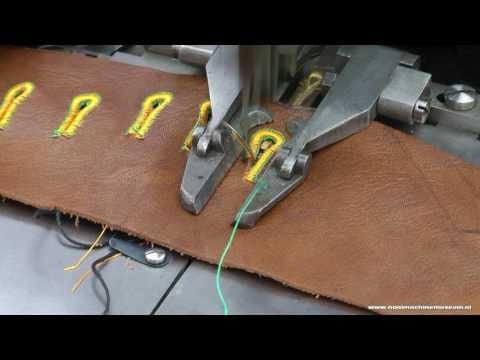
By this time, the shoe industry had also discovered the buttonhole machine. Shoes and mid-calf boots were primarily made with button closures at the time. Reece quickly responded to this particular need. In 1915, the “Reece Rapid” was introduced for this purpose. This machine also used the 2-needle system like the Reece J. The Rapid additionally featured a thread cutter and a built-in air pump that blew cool air around the needle with each stitch.

Around 1920, button-and-buttonhole closures on shoes gradually went out of fashion. For Reece, which relied heavily on this market, this posed a major challenge. In the city of Troyes (France) alone, the company leased approximately 600 buttonhole machines to three manufacturers, capable of producing a total of five million buttonholes per day.
To offset this loss, Reece decided to drastically expand its sales territory. From 1920 onwards, sales offices were opened worldwide, and independent representatives were appointed to explore new markets.
The next major technological leap came in 1935 with the introduction of the Reece 101. This machine, made partly of cast iron and partly of aluminum, was not only significantly faster but also far more reliable than earlier models. The Reece 101 was so successful that it was produced in its original form for many years—a testament to its technical quality and timeless design.


Around 1940, the “Reece S1,” a single-thread chain-stitch machine, was introduced. However, due in part to World War II, this machine was not successful.
After 1945, the “Reece S2” was launched. Also a single-thread chain-stitch machine, it was very fast and highly reliable, and it remains a major success to this day. See on the left.
The Reece "Piped Buttonhole"


In 1952, Reece introduced the “Reece PB” (Piped Buttonhole). At the time, it was called “The Machine that couldn’t be built.”
No one had expected that a machine capable of producing piped buttonholes could ever be created. This machine incorporated all the available technologies of the era, such as hydraulics, electrical engineering, and mechanics, among others.
A true marvel of engineering, the machine is often regarded as the predecessor of later sewing machines. Naturally, this machine was also offered for lease.
In 1958, the “Reece PW” was introduced for making piped pockets. Like the PB, it incorporated a great deal of advanced technology, but this time it also included pneumatics.

Around 1950, due to sharply increased demand, three new production facilities were established—two in the United States and one in Leiden. From 1959 to 1994, Reece buttonhole machines were built in Leiden. The machines could also be overhauled there and are recognizable by the stamped letters RB (Rebuild).
Unfortunately, I have only been able to find these job advertisements from the Leiden facility.


AMF and the Floating Needle
Unlike many other companies, Reece managed to survive the so-called “Grosse Firmensterben” in Germany and continues to exist to this day. The company initially entered into a partnership with AMF, and both later merged with Minerva.

AMF was known for its imitation hand-stitch machines, which were, for example, used to stitch the lapels of a jacket. This machine operated with a special needle that had two points and an eye in the middle—a concept originally patented in 1755 by Charles Frederic Weisenthal.
AMF called this the “Floating Needle” system. In this process, the needle is pushed through the fabric, caught from underneath, released from above, then caught from above and released from below, continuously repeating this cycle. This created a particularly neat and even stitch, closely resembling the appearance of hand-sewn work.
Left AMF “Floatingneedle” machine
Right: AMF with the cover removed, making the details more clearly visible


In 1960, AMF also introduced a button-attaching machine that operated on the same Floating Needle principle. The major advantage of this technique was that buttons were secured just as firmly as with hand sewing, making loose buttons practically a thing of the past.
Minerva, which later collaborated with AMF Reece, is a renowned sewing machine manufacturer founded in 1871. Today, the main headquarters of AMF Reece is located at the Minerva factory in the Czech Republic, where the tradition of technical innovation continues.
Reece Branches
Left: C.H. Verbeek Amsterdam
Right: Reece Paris, 1920.


Left London sedert 1914
Right: Berzack Bros, Johannesburg


Left: Fritz Zellweger, Zürich
Right: Reece Frankfurt, 1935


My Reece J. Buttonhole machines


Left: Highly magnified image of the lower needle.
Right: Needle, front and back.


Left: Adjustment of a Reece Rapid, for this part identical to the Reece J.
Right: Needle case.